
Watch our Video
This current charity fundraising trends report uses Charity Excellence data to look back at fundraising resilience 2020 to 2025 and what future trends might look like into 2026 and beyond. We have also created an update on the growing impact of the war in the Gulf.
For what the charity sector and Government could and should do to respond to the Cost of Living crisis, we created a Charity Sector Road Map for Recovery. There was zero interest in it.
Charity Excellence has aggregated all user data (anonymously), since 2018, using its 500+ health check metrics, which are combined into various models, enabling us to track in near to real time, issues such as wellbeing and sector adoption of AI. We also use 100 data tags that enable us to dice and slice data in a wide range of ways. Longer term, the plan is to marry our qualitative data with charity regulator quantitative data, and link to an economic library. That would enable us to use AI predictive analytics to enable sector policy making and resource allocation to be data driven and future focussed, to make the very best possible use of our limited resources.
| Our Charity Sector Data Store is now conservatively estimated to be 1 million data points. Reporting is via 5 interactive Power BI dashboards that are able to track, and dice and slice data in a large variety of ways.
One of the models reported is fundraising resilience, which tracks 83 metrics. |
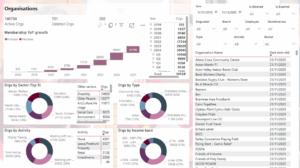 Power BI - Dashboard 5 |
We simply don't have the capacity or influence to fully exploit the huge and growing data set we have, so we plan to give it to those who do, as part of our next generation Charity Excellence 2.0.
The Covid crisis really began to impact in Mar 20, but the data shows sector fundraising falling from late 2019. We're not sure why. We have data from mid 2018 but our community numbers only really surged with Covid, so we're wary about how robust pre-2020 data is.
| What the data shows is that we reached bottom in Apr 20 The dip on the left) and were back to Mar 20 levels by Jul 20.
Fundraising resilience then continued to surge and to far higher levels than before, peaking in Feb 21 (the peak in the middle) before slowly falling back to 2019 levels. |
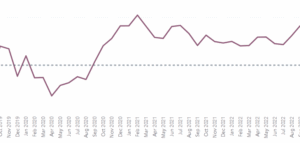 Nov 19 to Sep 22 |
Nobody really knows but in our Covid Lessons learned exercise, we use our grants data and other sources to estimate the Covid funding provided to have been in the region of £5 billion.
| In Aug 22, we used our Covid data to create a predictive model of the coming Cost of Living crisis.
This accurately predicted that it would be much deeper and longer than Covid and we'd hit bottom in Q1 23. Recovery began in Mar 23. This time it took a year for fundraising to return to previous levels; twice as long. |
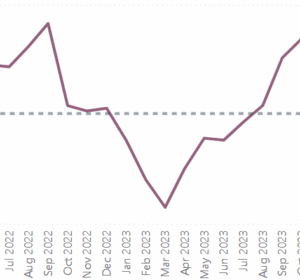 Jul 22 to Sep 23 |
| We'd been raising concerns about Government budget cutting and, having carried out a survey to support our data, in Sep 23 released our £1billion funding cut report.
This predicted a crash, driven by cuts to contracts of mainly larger charities but also in grant funding to small charities, because this is non statutory. |
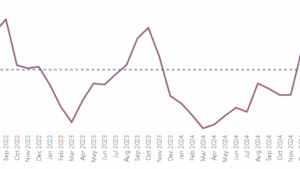 Sep 22 to Dec 24 |
This 3rd crisis was as deep as the initial CoL crisis. Fundraising recovery began in Apr 24 and ran through to Dec 24.
In an economic downturn, charities are hit doubly hard - costs increase (due to growing demand) and fundraising income falls. The reverse applies as the economy improves and this is what our data has shown post Covid and the Cost of Living crises.
| However, following the Government cuts of 2023, something different is happening this time - fundraising did not recover to previous levels.
It appears to have stabilised (far right in the graph), but at a much lower level than before. |
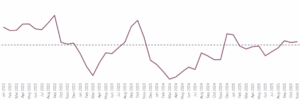 Charity Excellence Data Store - Fundraising Resilience Modelling (Jan 22 - Nov 25) |
The ACF report Foundations in Focus (2025) stated that in 23/24 grants increased by 12% and that applications surged dramatically, with some foundations reporting up to 400% more.
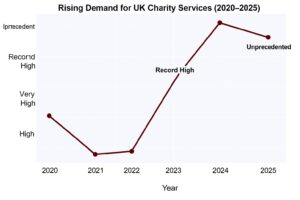 Copilot AI Generated Graph (2020 - 25) |
This was attributed to inflation, cost-of-living pressures, and increased demand for charity services. The graph on the left is estimated demand for charity services,
However, it is AI generated and, whilst it has used credible sources, there is no single data set available. The graph fits anecdotally with what we've seen and heard, so we believe it is indicative but we cannot say it is definitively correct. |
We think that demand is unquestionably a factor in falling fundraising resilience and, therefore, the budget announcements relating to welfare should help to reduce over-demand in 2026. Although cost pressures won't go away, as the NICs increase in the last budget, minimum wages in this one and the Apr 26 Living Wage increase continue to create growing cost pressures on charities with large workforces.
However, we do not think this is the whole picture. The factor we think needs to be added in is Government funding. The Government has been cutting departmental budgets year on year as well, not least in mid 2023, when our £1bn Funding Cuts report predicted the collapse in fundraising resilience that became the longest crisis so far.
Unlike fundraising, Government funding does not increase again as the economy recovers. What we're seeing is charities increasingly trying to replace lost public sector contract and grant funding with charitable funding. That's a major driver in why applications to foundations have hugely increased.
The Civil Society Covenant (2025) and HMRC Voluntary, Community and Social Enterprise Action Plan (2025–2026) both focus on equitable partnership working but what appears to be happening is that the charity sector is increasingly subsidising public sector delivery.
Given we have been unable to recover this time and the potential for a further crash begs the question of whether the sector will reach a tipping point. However, I think that uneven deterioration is more likely than a tipping point that takes down the whole system, thanks to the sector’s diversity, institutional trust, and adaptive capacity. However, we think that we may well see localised tipping points in subsectors and local ecosystems.
Longer term, AI may have an impact too. Either in supporting growing resilience or, less positively, super large charities potentially creating digital moats and becoming super dominant to the detriment of large and medium sized charities.
Some funders are now also saying growth in applications is due to a surge in AI bids. We think it's having some impact and that will almost certainly grow. However, our data shows (survey March 2026) that only 12% of charities use it a lot or all the time, and 25% use it regularly. It's now in routine use but the majority say they are using it to rework their drafts, explain complex ideas more simply and to tailor bids. Few say it's helping them to submit more bids.
The Economy. Fundraising follows the economy, and charity contracts and grants departmental budgeting.
Outlook. The UK’s economic outlook as of November 2025 shows slow but positive growth, tight public finances, and pressure on household incomes. GDP is forecast to grow modestly at around 1.2% in 2026, with inflation easing but real wages still lagging behind pre-pandemic levels. Disposable income remains squeezed due to high tax burdens and elevated interest rates, despite targeted relief like energy bill subsidies and fare freezes.
Unforeseen Events. We might hope that an unforeseen event such as a surge in exports or major trade deals might help boost the economy but there are also major downside risks such as the potential for the AI bubble to burst. In either case fundraising resilience would follow the economy. The war in the Gulf will definitely have some impact, with interest rates and inflation expected to increase. This may impact fundraising and also demand, as lower income households are disproportionately impacted by increases in household costs. If it goes on for some time, it has the potential to have substantial impact. Other risks to watch out for include a run on private equity and the US AI bubble bursting.
Departmental Budget Cuts. The government plans £15–20 billion in departmental budget cuts over four years, focusing on unprotected areas such as local government, justice, and transport, while shielding health, schools, and defence. If the Gulf crisis drives up bond costs, that may well make for a tough Autumn budget.
What That Means for Charities.
There doesn't appear to be anything on the horizon to suggest any significant improvement in fundraising over the next few years. The one possible area is if the Government were to follow through on its proposed investment in charity services. We proposed this in our 2023 report - to deliver that change would require a clear directive to be robustly imposed on Civil Service commissioners at every level, and that's down as far as borough councils. We think what'll happen is commissioners will do what they've always done and cut funding, making it our problem, not theirs.
But a sector mainly run by unpaid volunteers and with vastly lower overheads delivers huge comparable value for money. As charity services continued to contract, it would simply transfer the problem to our already over-stretched and far more costly public services.
A registered charity ourselves, the CEF works for any non profit, not just charities.
Plus, 60+ policies, 8 online health checks and the huge resource base. Quick, simple and very effective.
Find Funding, Free Help & Resources - Everything Is Free.
Thank You! My thanks to Sujith Murughan Mudaliyar who volunteered to build the Power BI dashboards that made this analysis possible and also to the OR Society pro bono team for finding him. Here's the case study.