Charity and Non Profit Websites - Agentic Web SEO
Non profit and charity website traffic is already being impacted by AI responses in browsers but as the move to browsing using AI agents accelerates, we will se the rise of the agentic web - an Internet built for bots. Charity web sites won't disappear but they will change dramatically. Both charities and regulators need to begin to prepare for that change because it is already happening.
Our AI Ready programme and Charity Excellence Learning free online AI training courses, give non profits everything they need to make effective use of AI and stay safe. Find Funding, Free Help & Resources - Everything Is Free.
Register Now!
What Does the Future of Charity Websites Look Like?
With Google increasingly using AI, charity website traffic is already being impacted (as is everyone else). This means fewer organic visits and, by inference, less spontaneous giving. What we're seeing now is increasingly browsing is through AI not traditional webs searches and it seems very likely that will grow, possibly very rapidly. The agentic web won’t eliminate charity websites, but it will change their role.
Think of your website less as a shop window and more as a data warehouse feeding AI ecosystems. Preparing now ensures your charity remains visible, trusted, and chosen in a future where donors increasingly delegate decisions to their AI assistants. Yes, this website uses structured data. We don't have the technical expertise to write coding and we've no money to pay for it, but we don't need it any more. I taught myself vibe coding and asked (the free version of) Microsoft's Copilot to write it for me.
What is the Agentic Web?
The agentic web is really important for charity websites - it's the next stage of the internet. Instead of people clicking through websites, AI assistants (like Copilot) will browse and act on their behalf. Supporters might simply say: “Donate £20 to Shelter” and their AI agent will handle the process without visiting the charity’s website.
Why Does This Matter for Charity Websites?
- Less website traffic: Donors may never see your homepage. Their AI agent will do the work.
- Data-driven visibility: Charities that make their information machine-readable will be more likely to appear in agent recommendations.
- Trust and transparency: Agents will prioritise charities with clear, verifiable data about impact, governance, and compliance.
- Competition for attention: If your charity isn’t “agent-ready,” you risk being invisible when donors ask their AI to choose where to give.
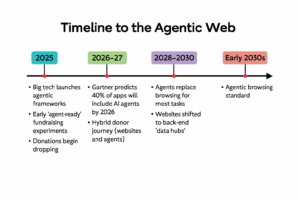
Timeline of Change
We know it's beginning to happen. At Charity Excellence we've ben rolling out structured data since late 2024 and built our first agentic web pages mid-2025, albeit they are only accessible by our own bots at the moment. We are now beginning to look at modular feeds and, ultimately, switching from logins to the system to making all of our data systems available to bots via APIs.
- 2025–2026: Early adoption. Agents begin handling simple tasks like donations and event sign-ups. Websites remain important but start losing direct traffic.
- 2027–2028: Growth phase. Agents become the preferred interface for many donors. Structured data and APIs become essential.
- 2029–2030: Mainstream use. Websites act mainly as compliance and transparency hubs. Donor journeys are almost entirely agentic.
- 2030 onwards: Agentic browsing becomes the default. Charities without agent-ready systems risk being left behind.
What Actions Should We Take to Future Proof our Charity Website?
Immediate (2025–2026)
- Add structured data (schema.org, JSON-LD) to donation and campaign pages.
- Ensure your charity’s information is accurate and up to date in public registries (Charity Commission, 360Giving, etc.).
- Begin testing integrations with fundraising platforms that support agentic AI.
Medium Term (2027–2028)
- Develop APIs for donations, events, and volunteering so agents can transact directly.
- Publish clear, machine-readable impact data (outcomes, case studies, annual reports).
- Strengthen your brand presence so donors recognise and trust your charity when agents suggest options.
Long Term (2029 onwards)
- Position your website as a compliance and transparency hub rather than the main donor interface.
- Collaborate with sector bodies to set standards for agentic fundraising.
- Invest in ongoing AI governance and ethics frameworks to ensure responsible use.
 |
There is very little doubt the agentic web is coming, we have a reasonably clear idea of how it'll work overall.
However, expect surprises, and we don't know just how fast this will happen.
This Copilot generated visual is our best guess as at end 2025. |
And finally, why this really matters to your charity....................
What is Agentic Fundraising?
Agentic fundraising means donations are guided or completed by AI tools, not just people visiting websites. These will help people find causes they care about, recommend charities, and even complete donations. In this new way of giving, charity websites are less important. Instead, charities need to make sure their information is easy for agents to understand and use.
We need to create standards so agents will know which charities are real, how to show donation options, and to ensure the process is safe. Here are some ideas for what agentic fundraising standards could look like:
Trust and identity
- Charities should be listed in official databases, like the Charity Commission E&W.
- Their mission and financial info should be easy for agents to read.
Donation options
- Donation types (like monthly or one-off) should be clearly described in a format agents can understand.
- Agents should be able to link directly to donation pages or use secure APIs.
Ethical use
- Agents should ask for permission before making donations.
- And agents must be able to recognise and respond appropriately when a potential donor is vulnerable.
- Charities should be able to choose whether they want to be found by agents.
Impact and feedback
- Charities should share results and updates in formats agents can pass on to donors.
Access for all
- Standards should work for charities of all sizes.
- They should support different languages and devices, including voice assistants.
Find the Funding and Free Help Your Charity Needs
A registered charity ourselves, the CEF works for any non profit, not just charities.
Plus, 60+ policies, 8 online health checks and the huge resource base. And our AI Ready programme and Charity Excellence Learning free online AI training courses, give non profits everything they need to make effective use of AI and stay safe.
Find Funding, Free Help & Resources - Everything Is Free.
Register Now!