
Watch our Video
For our Small Charity Crisis - Vital and Under Threat report charities told us they often couldn't find the support they needed but, if they could, it'd have real impact. They also told us they want local and functional (not national) support, and they don't want AI only solutions. There are 700+ UK infrastructure bodies and networks who can do that but they are often too small to be heard, they are under-resourced and under -funded, and they've been slowly closing for years.
We carried out a range of literature reviews and surveys over a period of 6 months, which is summarised in this report. It has been used for the final design specification for Charity Excellence 2.0 but is also a call to action to national sector bodies, grant makers and Government. With a potential new sector crisis looming, the need for them to act is both vital and also urgent. But unlikely, so on 1 Oct 26, we launched the Small Charity Fightback. Sign up to our latest support webinars on our events page and click Follow, to be notified of all the new ones coming. This report was last updated in Oct 26.
We think what you do is fantastically useful and can't think of anything
We are publishing this work as part of our ongoing commitment to champion and support small charities who make up 95% of the sector and also to give them data to help strengthen their funding applications.
With thanks to GSR Foundation whose funding makes our work possible.

We carried out surveys to determine the infrastructure support charities need and want.
Ease of finding the support needed.
59% of charities describe finding the support they needs as a struggle or really difficult and 5% don’t know where to look. Only 2% say they can find the help they need easily.
Animal charity completely funding by the public. Get next to no help at all with anything. All none paid vols, don't know where to turn for help needed and trustee support
Impact if the right help could be found.
Nearly three quarters (74%) said finding the help they need would make either make a real impact or have major impact. Less than 3% felt it would have little or no impact.
We are encountering increasing overhead costs and using up our reserves. We will close if this is not rectified!
I rated national infrastructure support as I did, not because it's not important but because it currently doesn't seem to be there! By far the most valuable support we receive or see is thanks to the wonderful networks like SIDCN and the amazing CEF resources!
| Support Provided | Weighted Average | Strong Support | Weak
Support |
| Functional support (e.g. volunteering, fundraising) | 8.3 | 74% | 8% |
| Local infrastructure support | 7.9 | 58% | 10% |
| Cause‑related support groups and networks: | 7.6 | 53% | 11% |
| Professional bodies for individuals | 5.6 | 13% | 33% |
| National infrastructure bodies | 4.6 | 16% | 41% |
We’re fed up of endless online volunteer sites with no local bureau or ‘recruitment agency’ for matching and attracting volunteers.
Charities are clear that what they want is practical, ideally local support for specific functional activities and skills, such as volunteering and fundraising. Cause related groups and networks are also strongly valued but not professional bodies for individuals or, lowest of all, national infrastructure bodies.
The Local Government Association is explicit that working with local infrastructure organisations is essential, not optional. They enable representative engagement, empower smaller VCSE organisations to overcome capacity barriers, and translate council priorities into effective local action. (Source: Local Government Association, Working with Local Infrastructure Organisations).
Unequal Distribution of Funding. Yet independent analysis shows an increasingly fragile infrastructure ecosystem. The 360Giving Infrastructure Analysis Report identifies around 700 infrastructure bodies, of which the majority are local or regional. Despite this, funding is heavily concentrated: the 20 largest organisations receive 37% of all infrastructure spending, while 80% have income below £1 million, and 29% below £100,000. Many of the largest bodies are national and London‑based. (Source: 360Giving, 2023.)
Huge and Possibly Increasing Levels of Closure. The 360 Giving report on infrastructure bodies in 2023 included data from 2011-22 showing that the numbers of registered charities and CICs, increased by 15%, the number of national infrastructure bodies fell by 4% and the numbers of local bodies by 25%. We don't know but given that our data shows the sector has been in almost continual crisis since 2020 and the current outlook is bleak, it seems likely it has been even worse in recent years.
Subsequently, at national level, the Small Charities Coalition (SCC) closed in 2022, the Foundation for Social Improvement (FSI) in 2023, Getting on Board in 2024 and, in 2026, Reach Volunteering announced closure but was saved by a £500k donation from a group of funders.
Charity Excellence came within 2 weeks of closure in 2023 but survived - we are the last of the small charities that provide broad based support to all small charities at national level. Ian McLintock.
We Need More Than Funding. Local VCSE infrastructure organisations need more than funding alone to be effective. They also need strong trust‑based relationships with VCSEs and statutory partners, the challenge of managing capacity and competing expectations, and the need for leadership and connection to sustain credibility and legitimacy in complex local systems. These findings underscore the need for support that strengthens relationships, peer connection and sector-wide capacity, alongside financial resources. (Source: NAVCA, Walking a Tightrope).
A Decades Long Crisis. I've read in sector debate that the announced closure of Reach Volunteering was an early warning canary in the coal mine moment for the sector. That is simply not true but does demonstrate the sector mindset, which doesn't include local infrastructure support. The bulk of infrastructure funding always has and, I think, almost certainly will continue to go to the larger and well know infrastructure bodies. But communities who want and rely on local infrastructure bodies are paying a heavy price for that.
Each closure results in the permanent loss of local knowledge, relationships and institutional memory, weakening the entire sector and making it harder to reach the charities and communities that most need support. Ian McLintock, Founder
Those Who Need Help the Most Hit Hardest. In Sep 26, the Joseph Rowntree Foundation published Essential but unequal: the need for social infrastructure in every place. This report looked at 'infrastructure'. much more widely than only support bodies by examining how community spaces, groups, organisations, activities and community workers support connected, resilient communities across England. It identified 686 “doubly disadvantaged” neighbourhoods, combining high socioeconomic deprivation with weak social infrastructure. These areas receive half as many small-to-medium grants as places with the strongest infrastructure, with awards averaging £6,000 less. Accessing funding requires skills, and sector knowledge and, often, relationships that those in disadvantaged communities often simply don't have.
The Need for System Change. Even if those at sector and Government level were collectively willing to consider moving the focus of funding from larger bodies and those they have existing relationships with, which seems very unlikely, there simply isn't enough funding. If you can't fund the existing system, you have to change it.
| On 1 Oct 26, we launched the Small Charity Fightback to catalyse that by supporting the smalls collaborate to help each other. Our first wave of support will roll out through to Easter 2027 and is focused on delivering help in the face of a coming very hard winter. We are improving our existing funding support, delivering new support and moving to actively supporting smalls to secure funding through a range of initiatives.
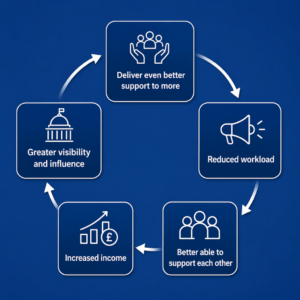
The strategic CEF 2.0 programme (see the operating model image on the right) is building but will take until end 2028 to fully impact. We've almost no funding and no expectation that the mainstream grant makers or infrastructure bodies will support it, so we've binned the more sophisticated tools we designed and will do it ourselves, with our partner companies and smalls, as and when we have the funding and capacity. A new way of supporting smalls - a UK wide social franchising network controlled by the smalls themselves. |
 |
Respondents were asked to rate how helpful a range of 8 potential resources would be. Responses show strong overall interest, but with clear variation by type of support. In part this was due to not all of the resources being applicable to all infrastructure bodies. For example, supporting income generation through promotion of trading and/or membership fees. Not all provide paid for services or membership but for those who do, it’s seen as very valuable.
Across all options, respondents consistently favour tools that increase visibility, voice, and access to funding, while more technical or embedded digital tools attract less interest but also hesitation. However, for even the lowest rated, the use of AI agents, nearly a quarter (23%) rated this 10/10. Our 2026 AI survey showed that charities see AI as very important but that they are still at early-stage adoption, without the oversight and management in place to fully exploit AI safely.
Nearly 63% believe that providing the support proposed would have a real or major impact. Only a small minority (5%) believe it would make little difference.
Responses to the statement “We feel financially secure and confident in our long‑term sustainability” reveal significant financial fragility. Only around 31% express clear confidence. In contrast, around 33% actively disagree, indicating they feel financially at risk. Within this group, around 5% describe themselves as very financially at risk, selecting the lowest possible score (1/10).
The 360 Giving data shows the number of small infrastructure charities closing over many years. We do not know but it seems reasonable to speculate that the ongoing crises since 2020 will have accelerated this. If world events trigger another crisis as our analysis has identified they may well do, then this will almost certainly be even deeper and longer than the previous ones. We currently assess the risk of another crisis to be high with recovery unlikely before 2028, if it were to occur. That would accelerate the rate of infrastructure charity closures.
In 2025, we created an Infrastructure search category in Funding Finder specifically to support infrastructure charities in securing funding.
The most important income stream is from trusts and foundations, followed by government contracts, with corporate funding and other fundraising less important but both more important than membership fees and income from services.
Securing funding is a critical issue but many infrastructure charities do not offer paid for services and/or fee paying membership. Consequently, these options are not relevant to many but are seen as very important by those who do.
In our survey, there is very strong agreement that infrastructure charities hold unique local or specialist knowledge that is not currently visible at a national level. This is being built into our design but we've taken 2 immediate steps in response:
Charity Excellence.
Literature Review Part 1 - Small Charities
Literature Review Part 2 - Small Infrastructure Charities
And have a read of our Grant Makers' Best Practice Guide, based on our survey and system data - a simple, non nonsense and low-cost way of improving grant making for everyone, including grant makers.
A registered charity ourselves, the CEF works for any non profit, not just charities.
Plus, 65+ policies, 8 online health checks, the Quality Mark and the huge resource base. Our AI Ready programme and our 11 free online AI training courses.
Find Funding, Free Help & Resources - Everything Is Free.