
Watch our Video
Small charities are the backbone of UK communities. They are often the first to respond when someone is in crisis and the last remaining source of help when other services disappear. Yet many are now fighting simply to survive. In June 2026, we published 2 summary reports of our research - the small charity crisis and the local infrastructure charity crisis.
The Small Charity Fightback is our response. It has two connected elements:
Together, they offer immediate support and the prospect of lasting change.
Small charities make up 95% of the charity sector. Mainly volunteer-led and operating with very low overheads, they reach people and communities that larger organisations often cannot. They understand local needs, build trusted relationships and deliver extraordinary value from limited resources.
But too many are struggling.
Two thirds told us that they find it difficult to access the resources they need and that better access would make a real difference. At the same time, the support available to them has been shrinking. In the decade to 2022, 25% of local infrastructure bodies closed. Given the years of crisis since then, the situation is almost certainly even worse now.
When a small charity closes, something important disappears with it: a safe place, a food service, a youth group, support for an isolated older person or help for a family with nowhere else to turn. And the hugely valuable local knowledge, trust and relationships built up over time are lost. The harm to the community is long lasting and creates even more pressure on the services that remain.
Our data identifies around 750 UK infrastructure bodies and networks, most of them small or locally based. Charities told us they value practical support and find local and specialist organisations particularly relevant to their needs. They were also clear that they do not want AI only solutions. The human relationship matters.
We listened. Charity Excellence 2.0 has been designed around what charities told us they need.
Supporting very large numbers of charities across areas such as fundraising, governance, compliance and organisational development would normally be prohibitively expensive. Digital technology and AI make it possible to deliver that support at very low cost. This is the foundation on which Charity Excellence 1.0 was built.
However, the smallest and most marginalised organisations, which are our priority, often face the greatest barriers to using technology. Our 2026 research reinforced what we had already heard: charities value our free resources, but they also want trusted people who understand their communities and can help them put that support into practice.
| Our solution is to combine the best of both.
Charity Excellence will provide its national reach, data, systems and technological expertise to hundreds of small and local infrastructure organisations already embedded within their communities. We asked these organisations about eight different ways we might support them. They wanted all eight, so we have incorporated every one into the operating model. The organisations involved are extremely diverse, so a single rigid system would not work. Instead, we will create a range of simple, single-purpose AI agents. Each non-profit will be able to select the tools that meet its own needs, while continuing to receive support from real people. |
 |
Our principle is simple: do it once, do it well and give it to everyone.
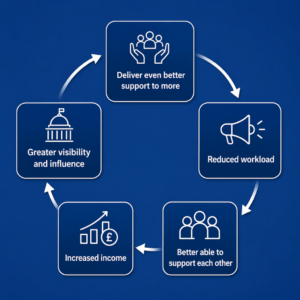
This approach will help local and specialist organisations reduce their workloads, increase their income, support one another, strengthen their influence and provide even better help to more charities.
Crucially, we are not starting from scratch. The communications reach, knowledge, data, systems, infrastructure bodies and skilled people already exist. We are bringing these valuable resources together in a new way, enabling those working on the charity front line to achieve even more.
That makes the programme comparatively low-cost, low-risk and capable of being delivered rapidly once the funding is secured.
Work on the new strategy began two years ago. The final six-month research and survey phase began in January 2026, the strategy was approved in June 2026 and pilot onboarding began in late summer. Subject to securing sufficient funding, the network will be rolled out between 2027 and the end of 2028.
Small charities cannot wait until 2028. They need help now.
There is already too little funding to meet the level of need, and that funding gap is unlikely to disappear. We therefore have to help charities make the most of every opportunity available to them.
Our immediate response includes:
This is not simply about improving systems. It is about protecting the small organisations that people turn to every day. It is about helping volunteers keep their doors open, enabling communities to retain services they value and ensuring that people in need are not left without support.
We have the strategy, evidence, technology, networks and experience. What we need now is the funding and partnership support to grow from supporting 60,000 to the entire UK nonprofit sector of circa 500,000 charities.
Supporting the Small Charity Fightback will not benefit just one organisation. It will strengthen the organisations that support communities across the UK, multiplying the impact of every contribution.
With the right support, small charities will not only survive this crisis. They will emerge stronger, better connected and equipped to help even more people. Sector bodies, infrastructure bodies, grant makers, anybody really is welcome to join - collaboration is the key and those who support or use the new UK wide social franchise network will also have a real voice in making the decisions about how that is done.
A registered charity ourselves, the CEF works for any non profit, not just charities.
Plus, 65+ policies, our charity AI library of tool kits and best practice guides, 8 online health checks, the Quality Mark and the huge resource base. Our AI Ready programme and our 11 free online AI training courses.
Find Funding, Free Help & Resources.